research
Working Papers
-
 Generalized Propensity Score Weighting for Continuous TreatmentsFangzhou Yu2025Working Paper
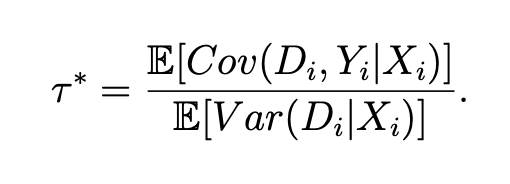
Estimating causal effects of continuous treatments is challenging as traditional methods rely on unstable inverse density weighting. We address this challenge by extending the balancing weights framework from categorical to continuous treatments. We shift the analytical focus from derivative weights to their Riesz Representers, which allows for efficiency analysis even when derivative weights are non-smooth. We derive the optimal balancing weight that minimizes the nonparametric efficiency bound and discover that the resulting optimal estimand corresponds exactly to the projection coefficient in a Partially Linear Regression. This finding establishes a novel causal interpretation for the projection coefficient under heterogeneity and provides an efficiency-based justification for its use in empirical practice.
@unpublished{yu2025generalized, title = {Generalized Propensity Score Weighting for Continuous Treatments}, author = {Yu, Fangzhou}, year = {2025}, note = {Working Paper}, } - Sensitivity of Parameter Estimates to Potentially Misspecified Estimation MomentsSeojeong Lee and Fangzhou Yu2025Working Paper
@unpublished{lee2025sensitivity, title = {Sensitivity of Parameter Estimates to Potentially Misspecified Estimation Moments}, author = {Lee, Seojeong and Yu, Fangzhou}, year = {2025}, note = {Working Paper}, } -
 Tests for Heterogeneous Treatment EffectsFangzhou Yu2024Working Paper
Recent advances in causal machine learning have facilitated reliable estimators of the average treatment effect (ATE) with valid statistical inference. However, applying similar techniques to conditional average treatment effect (CATE) poses significant inferential challenges. To bridge the gap between inference on the ATE and heterogeneity analysis, we propose three hypothesis tests to detect the existence of heterogeneous treatment effects. These tests inform researchers whether the treatment effect is constant across subpopulations defined by the covariates, thereby bridging the gap between inference on the ATE and the more ambitious task of fully characterizing those heterogeneities. Our tests build on three causal parameters: the projection of CATE on covariates, the variance of the CATE, and the variance difference between the potential outcomes. The test statistics are derived from the influence functions of the proposed parameters and are illustrated through Monte Carlo simulations and two empirical applications.
@unpublished{yu2024hte,
  title = {Tests for Heterogeneous Treatment Effects},
  author = {Yu, Fangzhou},
  year = {2024},
  note = {Working Paper},
}