research
Working Papers
-
 Identification and Inference with Machine-Learned InstrumentsFangzhou YuWorking Paper
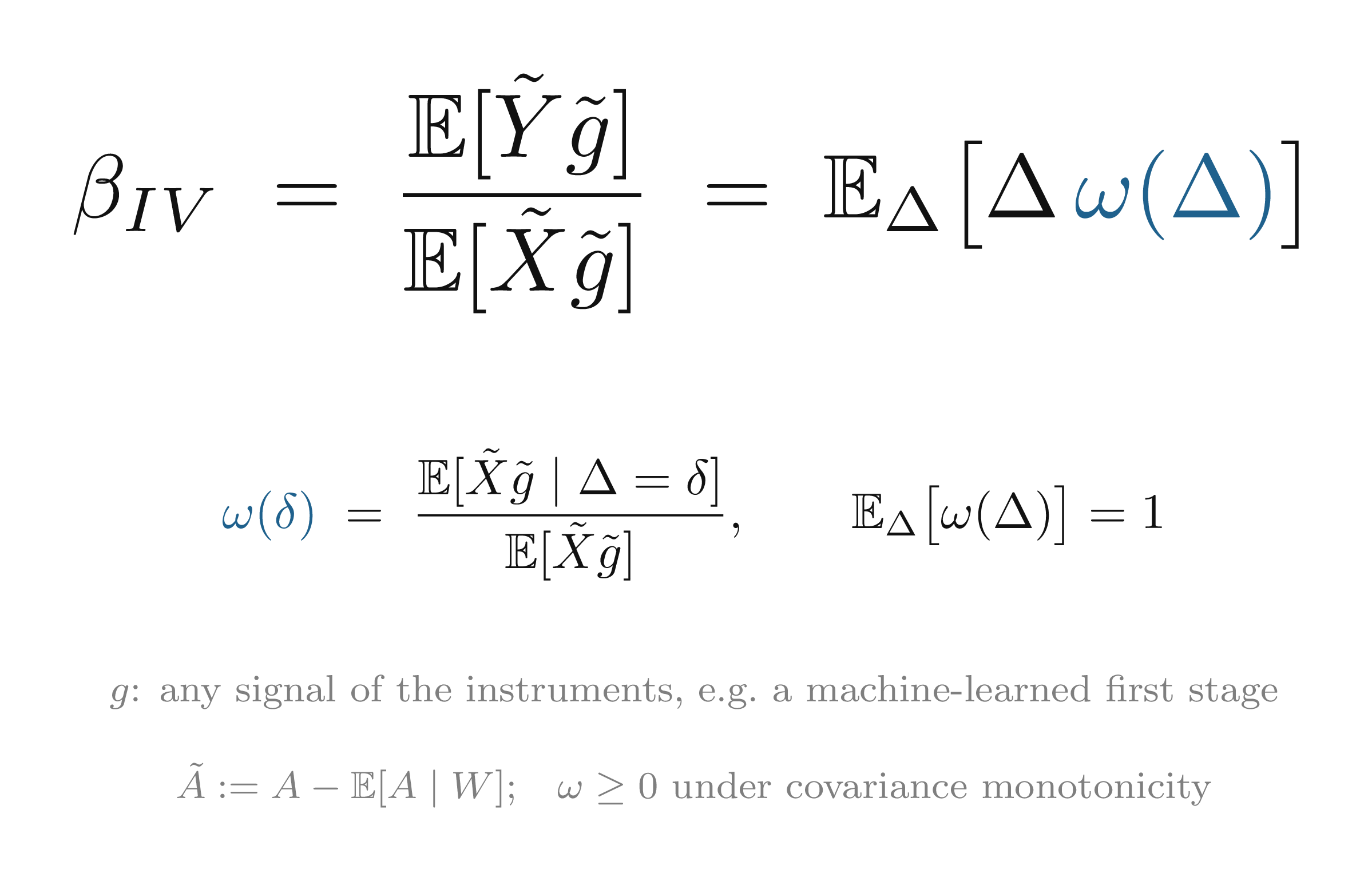
Instrumental-variables estimation increasingly pools many or high-dimensional instruments into a single machine-learned first stage, with rich controls partialled out. The resulting estimand, the partialled-out IV coefficient built from any signal of the instruments, is a signal-weighted average of the heterogeneous effects, which gives an opaque first stage a precise structural meaning. The average is convex whenever a covariance-monotonicity condition holds, and we provide a microfoundation for that condition based on vector monotonicity. With a learned signal, however, the usual debiased moment is not Neyman-orthogonal, and its first-order bias is a drift toward the learner’s own signal-weighted average, so naive inference remains valid only for that learner-dependent target. We construct a heterogeneity-robust orthogonal score that restores \sqrtN inference on the fixed, learner-invariant target at no efficiency cost, and provide a Hausman-type diagnostic and identification-robust confidence sets.
@unpublished{yu2026identification, title = {Identification and Inference with Machine-Learned Instruments}, author = {Yu, Fangzhou}, year = {2026}, month = jul, note = {Working Paper}, } -
 Two Margins in Difference-in-Differences with a Continuous TreatmentFangzhou YuWorking Paper
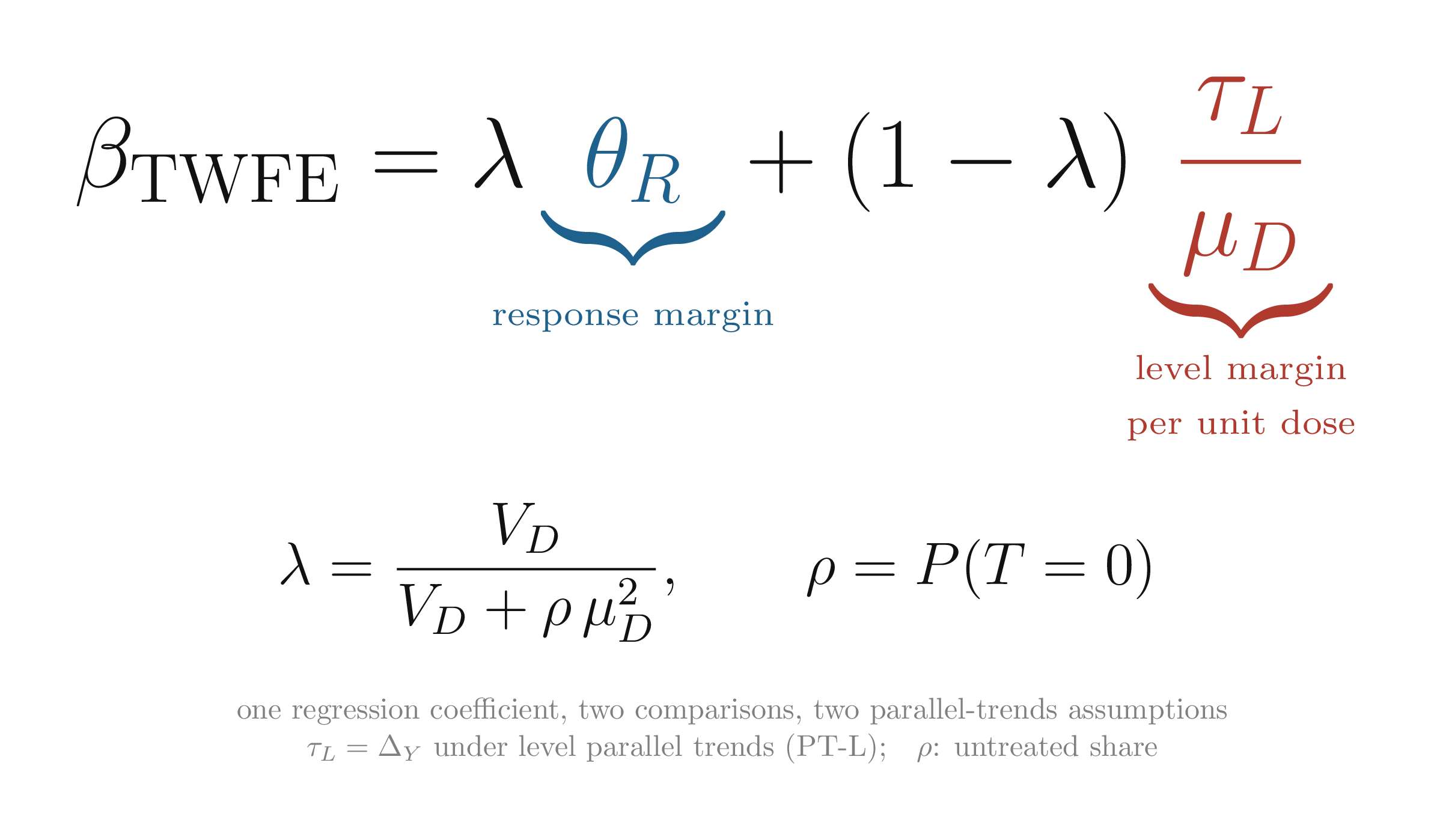
This paper studies difference-in-differences with staggered adoption and a continuous, time-invariant dose. Each cohort-time comparison contains two margins. The level margin is the average treatment effect at realized doses. Under level parallel trends it equals the level contrast between the treated cohort and not-yet-treated controls. The response margin is the within-cohort slope of the outcome change on dose. It uses no controls, and its causal interpretation requires a response parallel trends assumption and a restriction on selection on gains. We show that the continuous-dose OLS coefficient in each cohort-time comparison is a convex combination of the response index and the level contrast per unit of mean dose, with a mixing weight that depends on the not-yet-treated share. We provide estimators of both margins, joint inference across cohort-time comparisons and event-time aggregates, and a covariate-adjusted extension. In an application to hydraulic fracturing, the level leads reject a joint zero restriction, whereas the response-index leads do not. The continuous-dose OLS coefficient draws primarily on the level margin. We report the level and response margin separately.
@unpublished{yu2026margins, title = {Two Margins in Difference-in-Differences with a Continuous Treatment}, author = {Yu, Fangzhou}, year = {2026}, month = sep, note = {Working Paper}, } -
 Identification and Estimation of Optimal Continuous Treatment EffectsFangzhou YuWorking Paper
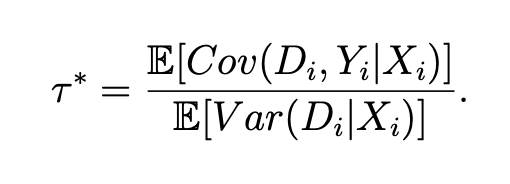
Estimating causal effects of continuous treatments is challenging because traditional methods rely on unstable estimation of the score of the conditional treatment density. We address this instability by extending the balancing weights framework to continuous treatments. By shifting the analytical primitive to the outcome weight, we guarantee a bounded statistical functional by design and bypass density derivative estimation. Within this framework, we characterize the nonparametric efficiency bound and derive the optimal continuous balancing weights under homoskedasticity and heteroskedasticity. Under homoskedasticity, the optimally efficient estimand coincides with the population projection coefficient in a Partially Linear Regression. Under heteroskedasticity, the optimal estimands center the treatment around a precision-weighted propensity score, generalizing the overlap-weighted effect of categorical treatments. Finally, we derive the efficient influence functions and develop \sqrtn-consistent estimators based on Double/Debiased Machine Learning, providing a semiparametric toolkit for empirical practice. We illustrate the proposed estimators through an application examining the effect of winning a lottery prize on labor supply.
@unpublished{yu2026efficient, title = {Identification and Estimation of Optimal Continuous Treatment Effects}, author = {Yu, Fangzhou}, year = {2026}, month = apr, note = {Working Paper}, } -
 Sensitivity, Informativeness, and Misspecification in GMM EstimationFangzhou Yu and Seojeong LeeWorking Paper
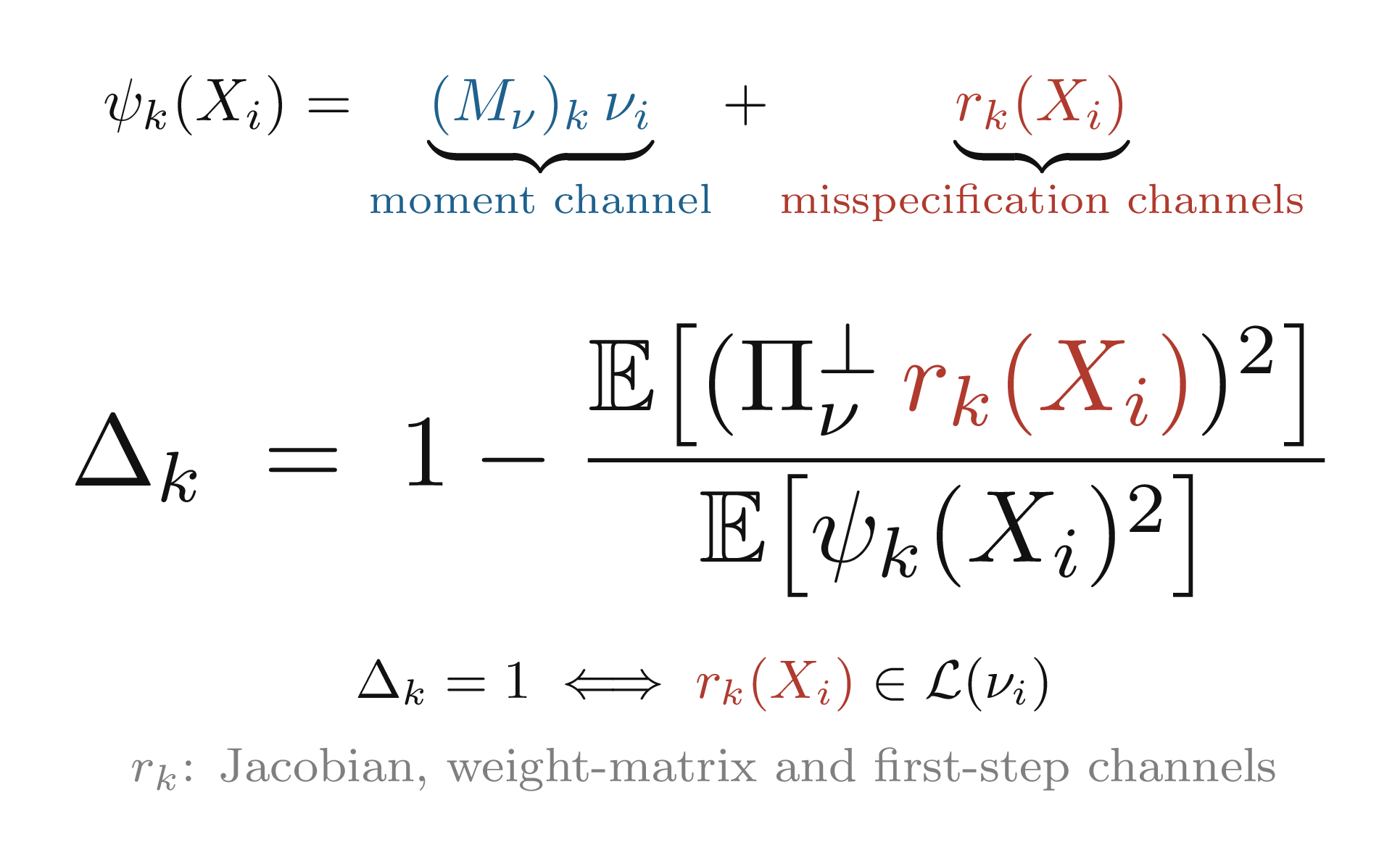
This paper develops a sensitivity and informativeness framework for GMM estimators that remains valid under general misspecification of moment conditions. Sensitivity is defined through the conditional expectation of the estimator given the moments and is characterized using the influence functions of the estimator and the moments. Under misspecification, sensitivity must be evaluated at the estimator’s pseudo-true probability limit, and additional sources of variation arising from the Jacobian and from estimated weight matrices become first-order relevant. We derive misspecification-robust sensitivity measures for one-step, two-step and iterated GMM estimators, and introduce an informativeness measure that quantifies the fraction of an estimator’s asymptotic variance explained by sampling variation in the moments themselves. This measure provides a notion of structural efficiency under misspecification that complements standard specification tests. Applications to the automobile demand model of Berry et al. (1995) and the consumption insurance model of Blundell et al. (2008) illustrate that accounting for misspecification can substantially alter sensitivity rankings and reveal large losses in informativeness.
@unpublished{yu2026sensitivity, title = {Sensitivity, Informativeness, and Misspecification in GMM Estimation}, author = {Yu, Fangzhou and Lee, Seojeong}, year = {2026}, month = apr, note = {Working Paper}, } -
 A Variance-Based Test for Heterogeneous Treatment EffectsFangzhou YuR&R, Econometrics Journal
This paper proposes a robust nonparametric hypothesis test for the existence of heterogeneous treatment effects. We focus on the variance of the Conditional Average Treatment Effect (CATE) as a natural omnibus parameter, where a non-zero variance implies the presence of relevant heterogeneity. Standard inference for this parameter faces a fundamental theoretical challenge. On one hand, evaluating variance components on the same sample leads to null degeneracy, where the asymptotic variance collapses to zero under the null hypothesis of homogeneity, invalidating standard Gaussian inference. On the other hand, decoupling the empirical processes via standard sample-splitting breaks the Neyman orthogonality of the doubly robust scores due to their nonlinear squared loss, which prevents the cancellation of first-order regularization biases. To resolve this challenge, we propose a novel Intra-Fold Sample-Splitting algorithm. By evaluating variance components on mutually disjoint subsamples while coupling them to identical out-of-fold nuisance estimators, our procedure achieves algebraic cancellation of the nuisance biases. We prove this restores consistency and asymptotic normality, and ensures Type I error control. Monte Carlo simulations demonstrate that the proposed test achieves superior size control against existing tests while maintaining high power. In an empirical application to the NSW job training program, the test detects significant heterogeneity that traditional nonparametric test fails to uncover.
@unpublished{yu2026variance,
  title = {A Variance-Based Test for Heterogeneous Treatment Effects},
  author = {Yu, Fangzhou},
  year = {2026},
  month = aug,
  note = {R&R, Econometrics Journal},
}